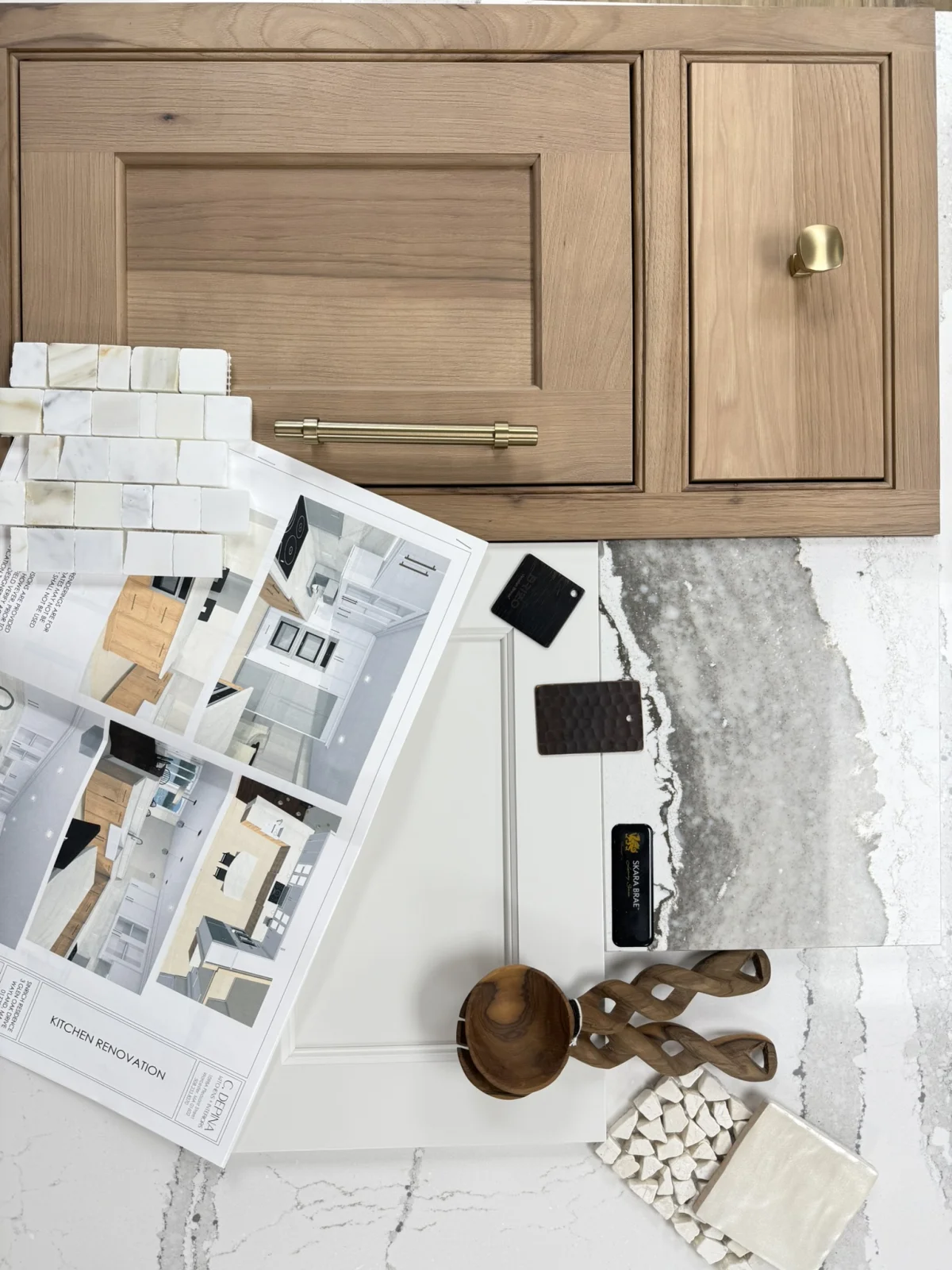

A kitchen renovation involves somewhere between 150 and 300 individual decisions. That is not an exaggeration. By the time you have chosen your cabinet style, door profile, finish, hardware finish, hardware style, countertop material, countertop edge profile, backsplash tile, grout color, paint color, light fixtures, and appliance handles, you have made more decisions in a weekend than most people make in a month.
And that is before the contractor calls to ask where you want the outlet on the island.
Decision fatigue is a well-documented psychological phenomenon. The more decisions you make, the worse your judgment gets on each one that follows. Your brain does not distinguish between choosing a cabinet pull and choosing whether to move a window. It just registers: another decision.
This shows up in renovations in predictable ways. Homeowners who were meticulous in the planning phase start approving contractor substitutions without reading the spec. Someone who spent weeks selecting tile chooses grout color in 90 seconds at the tile showroom counter. Couples who agreed on everything start arguing about things that do not actually matter that much. These are not character flaws. This is what happens when a brain runs out of decision bandwidth.
The good news: decision fatigue is manageable. It just requires a system. The best-prepared homeowners do not avoid all 300 decisions. They sequence them, protect their bandwidth, and know which decisions actually matter.
How do you batch renovation decisions to avoid overwhelm?
The biggest mistake homeowners make is trying to make all decisions at once, or letting them arrive randomly as the project progresses. The contractor needs to know about the outlet location this week, but that does not mean this week is the right time to finalize your backsplash.
A professional renovation plan sequences decisions. Design selections are made before demo begins, not during construction. Material orders are confirmed before lead times become a problem. Decisions that affect other decisions are made first.
When you batch decisions by phase, you create protected zones of bandwidth. You are not deciding everything at once. You are deciding the right things at the right time, with enough mental space to actually evaluate your options.
There is another reason to make decisions before construction begins, and it is not just about bandwidth. When decisions are made, documented on drawings, and written into your contract, they are no longer subject to a contractor's judgment call. Contractors work fast. When something is not specified, they default to their standard, not yours. A switch location, an outlet height, a door swing direction. These feel like small things until you live with them. If it is on a drawing and they deviate from it, the burden is on them to explain why. If it is not on a drawing, the burden falls on you, often in the form of a change order. Decisions made late are decisions made under pressure, and pressure is where your leverage disappears.
Kitchen Remodel Decision Timeline
Maps all 13 key decisions across 5 planning phases so you always know what to decide and when. Free for Renoversity members.
How do you limit your options before evaluating them?
Showrooms and online design platforms are not neutral environments. They are designed to show you everything, because exposing you to more options serves their interest, not yours.
Before you walk into any showroom or open any product website, define your parameters. Not preferences: parameters. Specific constraints that eliminate categories before you begin:
- A finish family (matte black, brushed nickel, unlacquered brass) and nothing else
- A tile format (3x12 subway, large format, zellige) and nothing outside it
- A countertop material category with a defined budget ceiling
When you arrive with parameters, you are choosing between 8 options, not 80. The quality of your decision improves and the cognitive cost drops significantly.
The easiest way to narrow your options is to work with a designer who has already done it for you. A good designer knows what works within your budget, what is available from local suppliers, and what will hold up over time. They eliminate the 80-option problem before you ever walk into a showroom.
If a full design engagement is outside your budget, even a single consultation to define your parameters is worth it. And there is no shame in the simplest version: find a photo you love, walk into a tile shop, point to it, and ask what they have in that direction within your budget per square foot.
Identifies your style direction before you set foot in a showroom. Takes about five minutes. Free for Renoversity members.
Which renovation decisions actually matter?
There is a decision hierarchy in every renovation:
Structure before surface. Layout before materials. Materials before finishes. Finishes before accessories.
Decisions at the top of that hierarchy are genuinely important. They affect cost, function, resale value, and your daily experience of the space. Decisions at the bottom often do not matter nearly as much as they feel like they do in the moment.
Experienced designers know this. Real time goes toward the decisions that cannot be undone. The ones that can be changed later move quickly. A cabinet knob can be swapped for $5 a pull. A poorly placed sink cannot.
When you feel yourself agonizing over something small, that is often a signal that your decision bandwidth is depleted, not that the decision is actually hard. Recognize it, step away, and come back when you are rested.
If you want a framework for sorting important decisions from small ones, this guide on what comes first in a kitchen renovation breaks down the sequencing in detail.
When is the right time to make renovation decisions?
Do not make renovation decisions when you are tired, hungry, mid-conflict, or in a hurry. Do not approve a contractor change order at the end of a long work day over text. Do not choose countertops on a Saturday afternoon after four hours in a showroom.
Set a decision window. Schedule two hours on a Saturday morning for design selections. Review contractor communications at lunch, not after dinner. When a decision feels urgent but the consequences are not truly time-sensitive, push it to your next clear window.
A structured way to respond to contractor requests in writing, on your timeline, without losing information in a text thread. Free for Renoversity members.
What does a good-enough renovation decision look like?
Perfectionism and decision fatigue feed each other. The search for the perfect answer keeps the decision open, which keeps the cognitive load running in the background, which depletes the bandwidth you need to make the next decision well.
For most renovation decisions, good enough is the right standard. Good enough means it meets your functional requirements, fits the budget, works with the other selections you have made, and you will not hate it in five years. That is a real bar. It is not settling. It is what professionals do on every project.
The homeowners who finish renovations feeling good about their choices are almost never the ones who agonized the longest. They are the ones who made structured decisions, trusted their process, and moved forward.
That is what a system gives you. Not certainty. Momentum.
If decision fatigue is hitting your household as a team, this guide on surviving a kitchen renovation as a couple covers how to protect the relationship while you protect the decisions.